Plainly
US-grown buckwheat comes mostly from North Dakota, Washington, Minnesota and New York, on about 27,000 acres a year (AgMRC). Worldwide, Russia and China grow most of the crop. Most makers do not tell you which of these places filled your pillow: 10 of 25 pages we read on 2026-11-11 named one (dataset). A page that names a state is stating it, not proving it.
This guide is for: people who want to know where the hulls in a buckwheat pillow grew, and how often sellers say.
Key Takeaways
Three figures carry this page: how often makers name the hull origin, how much US land grows buckwheat, and how much hull a mill gets from grain.
- 10 of 25 buckwheat pillow pages read on 2026-11-11 say where the hulls are grown, against 22 of 25 that say what the cover is made of (dataset). Only a trial window and a certificate number appear less often.
- About 27,000 acres of US farmland are planted to buckwheat in a typical year, and the 2017 census found most of it in North Dakota, Washington, Minnesota and New York (AgMRC).
- Milling 100 pounds of clean, dry buckwheat yields 18 to 26 pounds of hulls, so pillow fill is a by-product of a food crop (Purdue Alternative Field Crops Manual).
How many buckwheat pillow makers say where their hulls are grown?
Fewer than half of the maker pages we read name where the hulls grow, yet nearly all of them say what the outer cover is made of.
Our count: we read 25 product pages for buckwheat hull pillows sold to US buyers, all on 2026-11-11 (dataset). Every page got the same seven questions. The answers fell into three groups.
- Said by nearly every page: what the cover is made of, on 22 of 25 (dataset).
- Said by about half: how the hulls are cleaned (15 of 25), where the pillow is made (14 of 25) and the fill weight (14 of 25) (dataset).
- Said by fewer than half: where the hulls are grown (10 of 25), a trial or return window (8 of 25) and a certificate with its number (1 of 25) (dataset).
The table puts the seven counts side by side, each with its share of the 25 pages (dataset).
| Question asked of each page | Pages that answer it | Share (count ÷ 25) |
|---|---|---|
| Says what the cover is made of | 22 of 25 | 88% |
| Says how the hulls are cleaned | 15 of 25 | 60% |
| States the fill weight | 14 of 25 | 56% |
| Says where the pillow is made | 14 of 25 | 56% |
| Says where the hulls are grown | 10 of 25 | 40% |
| Gives a trial or return window in nights or days | 8 of 25 | 32% |
| Names a certificate with its number | 1 of 25 | 4% |
Hull origin sits in the bottom group. You are more likely to learn about the fabric around the hulls than the field they grew in. A "made in" line answers where the pillow was sewn. It says nothing about the field.
How was the count of maker pages done?
Each page was saved as read on one day, and a yes needed a quote found on that page. We counted what makers declare, not whether it is true.
The population is 25 buckwheat hull pillows sold to US buyers, and all 25 listed pages were readable on 2026-11-11 (dataset). For each pillow we read the maker's own product page. Marketplaces and review sites were left out.
Each page was saved as it stood when we read it. Then each of the seven questions got a yes or a no. A yes needed a quote found on the page. A no means no quote was found. A line such as "grown in North Dakota" counts, while a farm photo or the word "natural" on its own does not.
This is a count of declarations, not a test. Nothing was weighed, timed or sent to a lab. A yes means the maker says it. It does not mean anyone checked the claim.
The CSV has one row per pillow and one column per question, so you can check any count here against its rows. The site's method page sets out the rules behind every count we publish. A no can also mean the answer sits somewhere else on the maker's site, such as an FAQ page. We kept to the product page because that is where you see the pillow and its price together, and it is the page most people read before they buy.
Where are buckwheat hulls grown around the world?
Russia and China grow most of the world's buckwheat, and the United States ranks seventh by tonnage in the latest United Nations farm figures.
The UN Food and Agriculture Organization keeps the world's crop figures. Its FAOSTAT data for 2024 puts world buckwheat output at 1,970,230 metric tonnes, with Russia at 979,962 and China at 504,358 (AtlasBig, from FAOSTAT). Those two countries grew about three-quarters of the world's buckwheat. The United States ranked seventh, at 86,536 tonnes or 4.4% of the total (AtlasBig, from FAOSTAT).
| Country | 2024 output, US tons (metric tonnes) | Share of world output |
|---|---|---|
| Russia | about 1,080,000 (979,962) | 49.7% |
| China | about 556,000 (504,358) | 25.6% |
| United States | about 95,400 (86,536) | 4.4% |
| World | about 2,172,000 (1,970,230) | 100% |
US tons in the table are metric tonnes times 1.102.
Hulls travel too. One US maker's own page lists China, Russia, Kazakhstan and Ukraine among the big buckwheat exporters (Hullo, bulk hulls page). A pillow sewn in the US could hold hulls from any of them. Unless the page names a place, you cannot tell which.
Where in the United States is buckwheat grown?
Most US buckwheat grows in a few northern states, chiefly North Dakota, Washington, Minnesota and New York, on a small and shifting acreage.
Buckwheat is a minor US crop. The Agricultural Marketing Resource Center puts it at about 27,000 acres planted each year (AgMRC). In the 2017 farm census it grew in more than 20 states, with most of it in North Dakota, Washington, Minnesota and New York (AgMRC).
Other sources give different totals, and the gap between them is wide.
| Source | What it reports | US buckwheat acres |
|---|---|---|
| Lancaster Farming, from the 2007 Census of Agriculture | Acres harvested in 2007, on 337 farms | 24,760 |
| AgMRC | Acres planted in a typical year | about 27,000 |
| Iowa State Extension | Total US acreage in recent years | more than 70,000 |
The figures disagree by more than double. They come from different years, and some count acres harvested while others count acres planted. Iowa State's page also says some farmers in north Missouri have grown buckwheat under contract with a processor (Iowa State Extension).
For you, this means a page that says "North Dakota" names one of the main growing states. A page that says only "USA" could mean any of them. It tells you less.
What does an origin statement on a pillow page look like?
Origin claims range from a named state to a region to the word USA alone. A named state tells you the most, but the maker is still the only source.
Seven seller pages we read while writing this guide show the range. They are examples, not rows from the count above. The precision column is our judgement, and no seller grades its own wording this way.
| Seller page | Where it says the hulls grow | Precision (our judgement) |
|---|---|---|
| Hullo buckwheat pillow | Montana and North Dakota, for its current stock | Named states |
| Sachi Organics pillow, on a Vermont retailer's page | North Dakota | Named state |
| Waterglider bolster, Amazon listing | Fields of North Dakota | Named state |
| Turmerry buckwheat pillow | US Midwest | Region |
| ComfyComfy hulls page | Western US, from a farmers' cooperative | Region |
| Bucky travel pillow | US grown | Country only |
| Sachi Organics hull refill | Grown in the USA | Country only |
Two details stand out. Sachi Organics shows up at two levels: a retailer's page names North Dakota, while the maker's own refill page says only the USA. Hullo ties its answer to its "current stock." The source can shift by batch.
Turmerry splits its parts by country, saying the cover is made in India while the hulls are grown and the pillows assembled in the USA (Turmerry). Read "made in" and "grown in" as two separate claims. If you want the state, ask the seller, and ask whether the answer covers the pillow you would receive.
How does a hull get from a buckwheat field into a pillow?
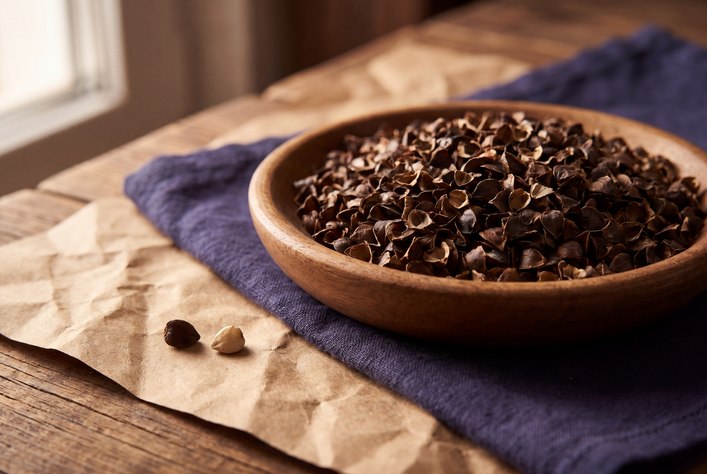
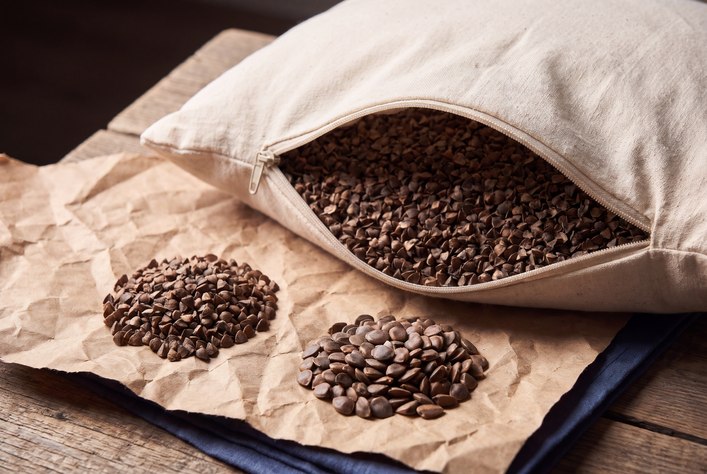
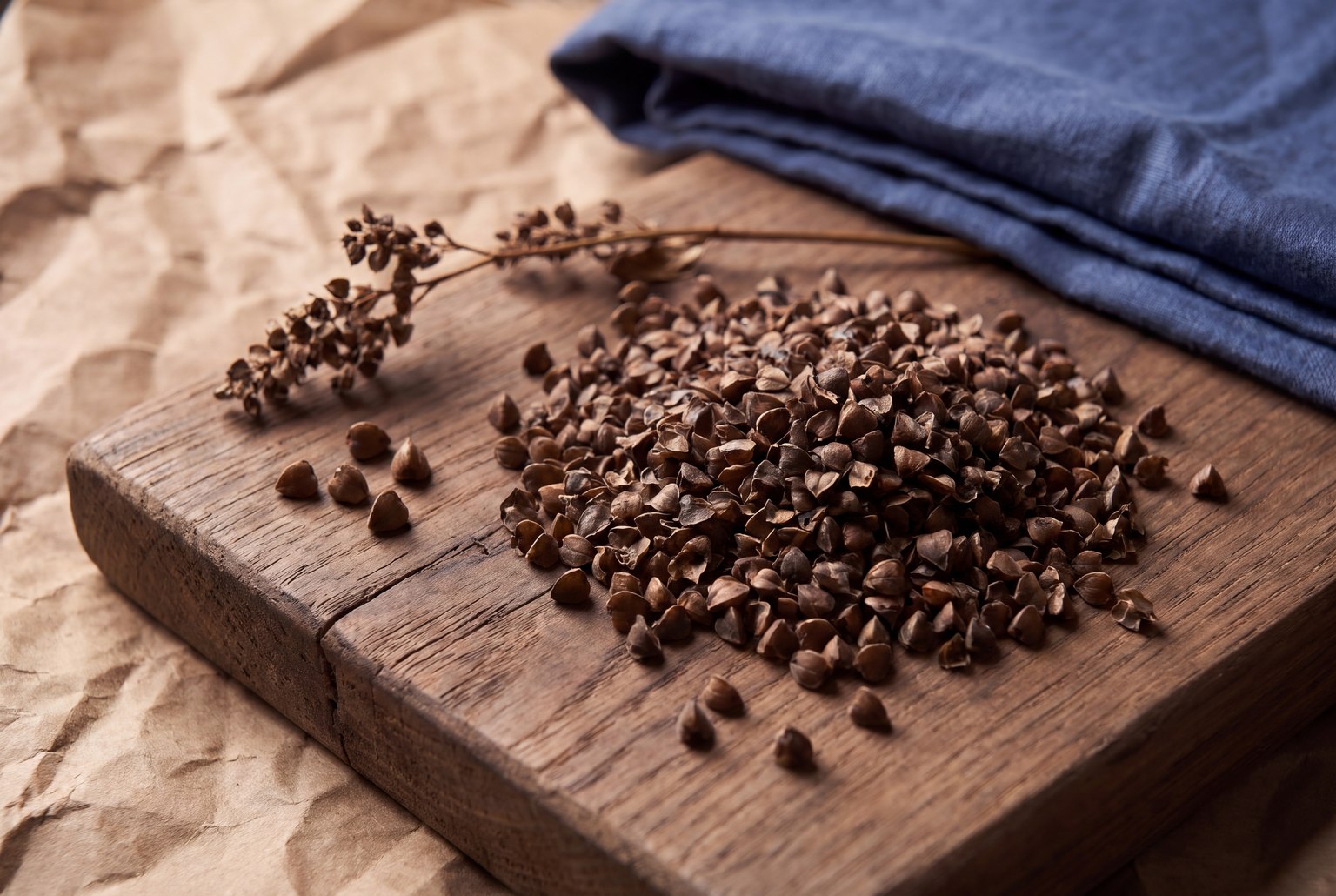
Hulls are a by-product of milling buckwheat for food. The grain is cut, dried and dehulled, and the hulls are cleaned before they become fill.
Buckwheat is grown as a grain. The hull is the hard shell around each seed. Purdue's crop manual gives the milling split: 100 pounds of clean, dry buckwheat yields 18 to 26 pounds of hulls, along with 60 to 75 pounds of flour and 4 to 18 pounds of middlings (Purdue Alternative Field Crops Manual).
That ratio works backwards too. Suppose your pillow holds 9 pounds of hulls. The mill had to process between 9 ÷ 0.26 and 9 ÷ 0.18 pounds of grain, or roughly 35 to 50 pounds. The hulls stay with the grain until the dehuller splits them off.
The grain is dried first. The same manual says seed should be dried before storage if its moisture is above 16% (Purdue Alternative Field Crops Manual). Iowa State Extension puts the long-term storage target at 15% or below (Iowa State Extension).
The field and the mill need not be in the same state. Hullo's page says its current hulls grew in Montana and North Dakota and were milled and air-cleaned in North Dakota (Hullo). So an origin claim can describe the field, the mill or both. Our guide on how hulls are separated, sifted and cleaned covers the steps after milling.
What else do makers leave off their pillow pages?
Certificate numbers and trial windows are the rarest details on the pages we read. Fill weight and where the pillow is made appear on about half.
Origin is not the only gap. On the same 25 pages, 14 state the fill weight, 8 give a trial or return window in nights or days, and 1 names a certificate with its number (dataset). The certificate result is the thinnest in the count. We do not print that number or name the page, because the count records only whether a number is named.
Each gap costs you something different. Fill weight tells you how much hull is inside. That sets your head height. Our guide to how much a buckwheat pillow weighs explains why the weight matters. A trial window tells you how long you have to decide whether you can sleep on hulls at all.
A certificate number lets you look a claim up with the body that issued it. Without one, an organic or clean claim rests on the maker's word. Our guide on what makes a buckwheat pillow organic covers how that claim is earned. Some sellers explain the gap themselves. ComfyComfy says its hulls are grown without chemicals but are not certified organic, because certification is onerous and expensive for the growers (ComfyComfy). That tells you what the hulls are not, as well as what they are.
What can this count not tell you?
It cannot tell you whether any claim is true, how makers outside the set behave, or whether a page changed after the day it was read.
A count of claims cannot confirm a claim. If a page said North Dakota, it counted as a yes. We did not ask the farm, the mill or a lab. Treat each yes as the seller's word.
The set has edges. It covers 25 pillows sold to US buyers, read on their makers' own pages (dataset). Makers outside that list may say more, or less. A maker who names the farm only on a marketplace listing shows up here as a no.
Pages change. Hullo's 2018 page says its hulls are grown, milled and air-cleaned in North Dakota (Hullo, made in USA page), while its current product page names Montana and North Dakota (Hullo). A count taken on one day cannot see a change like that. So the CSV carries its read date.
What you can do with that: ask the seller three things before you rely on a claim. Ask which state or country grew the hulls. Ask whether that answer covers the batch you would receive. Then ask where the hulls were cleaned, since the mill and the field can sit in different places.
Common questions
Short answers to the questions people ask next about hull origin, labels, imports, the data file and how much grain a pillow uses.
Are buckwheat hulls grown in the United States?
Yes. About 27,000 US acres are planted to buckwheat in a typical year, mostly in North Dakota, Washington, Minnesota and New York (AgMRC). US-grown fill means hulls milled from that grain.
Does "made in USA" mean the hulls were grown in the US?
Not on its own. A pillow can be sewn in one place from parts grown elsewhere. Turmerry's page, for example, says its cover is made in India and its hulls are grown in the USA (Turmerry). Look for a separate "grown in" line.
Do pillow hulls come from Russia or China?
Some can. Those two countries grew about three-quarters of the world's buckwheat in 2024 (AtlasBig, from FAOSTAT), and one US maker names both among the big exporters (Hullo, bulk hulls page). A page that names no place leaves this open.
Where can I get the data behind this count?
You can download the CSV file. It has one row per pillow and one column per question, with the read date. Check any count on this page against it.
How much buckwheat grain does one pillow's worth of hulls take?
Milling 100 pounds of clean grain leaves 18 to 26 pounds of hulls (Purdue Alternative Field Crops Manual).
So 9 pounds of hulls takes roughly 35 to 50 pounds of grain. That is 9 ÷ 0.26 and 9 ÷ 0.18, rounded.
Why would a maker leave out where the hulls grew?
Pages rarely say why. One maker ties its origin statement to its present batch of hulls, which suggests the source can change from one batch to the next (Hullo). If your pillow's page is silent, ask the seller directly.
Sources
Hull pillow references used above, with the heading under which each one is cited.
- AgMRC (agmrc.org), under “Key Takeaways”; “Where in the United States is buckwheat grown?”; “Common questions”.
- Purdue Alternative Field Crops Manual (hort.purdue.edu), under “Key Takeaways”; “How does a hull get from a buckwheat field into a pillow?”; “Common questions”.
- AtlasBig, from FAOSTAT (atlasbig.com), under “Where are buckwheat hulls grown around the world?”; “Common questions”.
- Hullo, bulk hulls page (hullopillow.com), under “Where are buckwheat hulls grown around the world?”; “Common questions”.
- Lancaster Farming, from the 2007 Census of Agriculture (lancasterfarming.com), under “Where in the United States is buckwheat grown?”.
- Iowa State Extension (extension.iastate.edu), under “Where in the United States is buckwheat grown?”; “How does a hull get from a buckwheat field into a pillow?”.
- Hullo buckwheat pillow (hullopillow.com), under “What does an origin statement on a pillow page look like?”; “How does a hull get from a buckwheat field into a pillow?”; “What can this count not tell you?”; “Common questions”.
- Sachi Organics pillow, on a Vermont retailer's page (naturalmattressvt.com), under “What does an origin statement on a pillow page look like?”.
- Waterglider bolster, Amazon listing (amazon.com), under “What does an origin statement on a pillow page look like?”.
- Turmerry buckwheat pillow (turmerry.com), under “What does an origin statement on a pillow page look like?”; “Common questions”.
- ComfyComfy hulls page (comfycomfy.com), under “What does an origin statement on a pillow page look like?”; “What else do makers leave off their pillow pages?”.
- Bucky travel pillow (bucky.com), under “What does an origin statement on a pillow page look like?”.
- Sachi Organics hull refill (sachiorganics.com), under “What does an origin statement on a pillow page look like?”.
- Hullo, made in USA page (hullopillow.com), under “What can this count not tell you?”.